Showing posts with label happiness. Show all posts

Wednesday, December 27, 2017

The Quest for Cadence:How improving my running form elevated my passion for running and life


“Your foot is slapping!” my running partner stated as we maneuvered our way along the sidewalks of the suburban neighborhoods near my home on a 5 mile run. To which I replied, “actually my foot is clapping and I’m giving you a standing ovation.” I used humor to disguise my concern but in my mind I was curious. She may not have the same caliber running resume as I do but she is smart and very much tuned in to the sights and sounds of her surroundings, more so than anyone I’ve ever met. I knew I occasionally slapped, but since I had become acclimated to it I thought nothing of it.  I have been a runner since high school and have accumulated a very respectable resume. Now at the age of 50 I am still running strong. Surely my stride must be fine I thought. Or was it?


Just how much slapping was I doing? I found out a couple of weeks later.  Not long ago I purchased a video camera with some cool features that appeal to my inner geek, one of them being slow motion video. I looked at my alleged foot slapping as an opportunity to use my new toy and do a self-analysis of form.  Several takes were done but one was really all it took.  It was all so very clear. My left foot was striking appropriately (on the mid and forefoot), but my right foot was going rogue. The heel was hitting the ground first, albeit lightly, but it was just enough to cause the forefoot to slap when it hit the ground. I had to face facts. I was, “gulp”, a heel striker. This had to change!


As both a coach and a runner I have devoted myself over the years to becoming educated on the principles of good running. So, I knew what I had to do, this was a job for the dreaded “D” word. That’s right, I had to do drills.  Most runners just want to run, putting one foot in front of the other letting their feet fall where they may. The idea of improving form and becoming more efficient sounds appealing, but because doing drills detracts (at least initially) from the joy of running on auto-pilot, not all runners are willing to do them.


Running is a natural movement, but the highly cushioned shoes we have today enable our feet to strike the ground in an unnatural manner, leading to an inefficient stride. If we stride inefficiently it’s less noticeable because the shoes hide much of the impact the body is experiencing. If this happens regularly the repetition of inefficiency leads to inefficiency becoming the norm.


Modern living also takes its toll. Things such as daily car driving, frequent use of computers, and excessive staring at smart phones can promote muscle imbalances. Muscle imbalances alter the natural movement of the body as stronger muscles work to overcompensate for the weaker ones. In a nutshell, we move more awkwardly. Not long ago this point was amplified to me while I was running on a local school track. While doing intervals I had to momentarily pull off to the far outside lane as dozens of middle school students came out to run 800 meters as part of their PE class. I couldn’t help but notice how, having not yet been exposed to several decades of modern living; each and every student completed both laps with absolutely perfect form.


Just as repetition of inefficiency leads to inefficiency as the norm, repetitions of efficient running motion ultimately leads to efficiency becoming the standard.  Drills may not be fun but they are effective at providing frequent and consistent exposure to the desired skills. In the case of running, they enable steady forward progress towards efficient movement patterns becoming effortless.


After coming to grips with the fact that drills were a necessary part of the prescription for efficient running, I had to decide which ones were worthy of my attention. I have learned many in my coaching and running career. In my 17 years as a coach I’ve learned that if the athlete has too many fundamentals to focus on at one time it can lead to feelings of frustration from feeling overwhelmed. This definitely doesn’t enable the right mindset for learning. I decide to practice what I preach and hand pick what I feel are the most beneficial drills for my situation.  I decided on these, which I acquired from various sources;


Keep stride frequency at 170-180 strides per minute: This is widely considered to be the most efficient zone to be in, with 180 being considered optimum.* That being said, we each have our own form intricacies that can cause a bit of deviation from this number. As long as the stride frequency is no lower than 170 it is generally considered to be at an effective rate. This is because if your stride frequency is below 170 it’s highly likely you are over-striding, resulting in heel striking.


To keep track of my stride frequency I chose to utilize a technique I learned in the classic book Daniels Running Formula by the legendary Jack Daniels, PhD. This technique involves counting every right foot strike for one minute and then doubling that number. By this method, if your foot strike count is within the range of 85-90 you are within that ideal zone. I do this periodically throughout my run, adjusting my stride accordingly based on the outcome. Over time these incremental focuses on stride rate will train the body to naturally and effortlessly run at the desired rate.


Run like you’re stepping on hot coals:  The reasoning behind having a high stride per minute count (or stride frequency) is that the feet are in contact with the ground for less time due to a quicker turnover. This leads to less stress on the body with the added bonuses of reduced likelihood of injury and a delayed onset of fatigue. In order to accomplish this high stride frequency it is helpful to think of the ground underneath you as being covered in hot coals.  In order to avoid being burned, you’ve got to stride quickly and lightly.


 Keeps the hips pressed all the way forward: The most common issue I’ve encountered in runners is excessive forward leaning at the waist. While a forward lean is necessary in order to use gravity to your advantage and not require as much power from the legs, the lean should come from the ankles. When doing so a straight line should be formed from the ankles to the shoulders. To get into this proper forward lean position a valuable technique is, when beginning your run keep a straight body and fall forward from your ankles. I obtained this information from the book Chi Running by Danny Dreyer (a great read which I highly recommend).


Once you begin your run the next trick is to maintain this forward lean position. This is where the hip position comes into play. The hip position emphasis is something I acquired from watching Without Limits, a classic sports movie about the legendary Steve Prefontaine (Pre). In the film, Bill Bowerman, Pre’s coach at the University of Oregon (played by Donald Sutherland) instructed Pre to press his hips all the way forward (albeit with an R-rated description) after watching Pre run with the aforementioned lean at the waist. After watching the movie I applied this technique to my own training and found it to be highly effective. I was definitely going to keep this one in the mix. If it was good enough for Pre it was good enough for me.


When first learning of the ideal stride frequency I of course had to count mine. I consistently came up with 170, but sometimes as low as 168. Yikes!  Okay, not bad really.  I was happy that on average I was at least in the zone, but I wasn’t going to rest on my laurels. I wanted to see if I could improve, so I kept at it, periodically working in some drills while on medium to long runs. Unfortunately, my efforts didn’t occur frequently enough to promote significant improvement.


Now that I was a bona fide foot slapper though, I was on a mission to eradicate the slap and run with utmost efficiency. During each run I would randomly and regularly practice a different drill. Press the hips forward for this minute, focus on stride count for that one. Then I would pretend the road suddenly turned into a bed of hot coals. I had no choice. I had to move efficiently across them. 


Little by little the pieces of the running form puzzle came together.  I hit 172 strides per minute. I took shorter, quicker steps bringing my stride frequency up to 176. At one point I even hit perfection with 180.  Woohoo!!  “Now I’m cooking with gas” I thought to myself, remembering the saying I often heard as a child when things were going right.


This 180 stride frequency proved to be elusive, disappearing as quickly as it arrived. But I had experienced the feeling of running at the perfect frequency. My body knew what it had to do to get there, making it more likely to return. Even though I have yet to make 180 my standard, no longer am I stuck at 170. My efforts have elevated me to an average of 174, but I’m not stopping there. I will continue my pursuit of excellence. 


My experiences with working on form emphasized to me how amazing of a sensation it is to experience improved skills. It’s so easy to think something is “good enough” and not try to reach the next level. As a result we miss out on the feelings of jubilation that go along with skill enhancement. My more efficient form has elevated my passion for running to a new level. Not only am I enjoying running more (something I never imagined was possible because I already love it tremendously) but all indications thus far point to me being faster as well. This passion has spilled over into my life as a whole as I contemplate what else I can accomplish. I can’t wait to find out!


I encourage everyone to never stop working on improving, in running or any other aspect of life. Do not deny yourself the joy and empowering feelings that accompany your accomplishments. You never know what hidden talents you may uncover. Keep your mind open to absorbing information from all sources and people: a tip you automatically dismiss could have been a life changer.


* Some elite runners cadence actually goes higher than 180. In the Nike Breaking 2 project, for example, Eliud Kipchoge's cadence ranged from 180-185 strides per minute.

Monday, February 1, 2016

Flowing into Happiness

It’s 8 am. A fresh coat of snow blankets the earth and a light fog fills the air as I begin my standard Sunday long run.Today I’m running with my headphones for some musical inspiration. My musical selection is quite diverse but even with it set to shuffle I feel like my ipod can sometimes read my mind, as it often picks the right song at the right moment. As I tread lightly across the new fallen snow to get a sense of the degree of slipperiness, Beethoven’s Moonlight Sonata is the first melody that serenades my eardrums.


One might not associate this with a workout song but its cadence is perfect for warming up. And despite being about moonlight it seems to be fitting. Being early in the day on a Sunday the rest of the world seems to still be at rest, providing a similar stillness as the moonlight hours. It’s just me running through a silent snow covered foggy town. The song seems to be the soundtrack for this moment, emphasizing the so called loneliness of the long distance runner.


I love my long runs, they provide me with a form of meditation, an opportunity to get inside my head and clean out the gunk that has accumulated from a hectic work week.
Despite the fact that I’m running while listening to music I am still very much able to clear my head. In fact, exercising to music has been shown to induce a state of ‘flow’ or ‘getting into the zone’.


Flow is the point during an activity in which mind and body work in perfect synch, you are totally in the moment and movements seem to flow without conscious effort. Recent research at Brunel University’s School of Sport and Education showed that music can make the experience of cardiovascular exercise far more positive. Promoting a state of flow is a way in which this happens. Researchers concluded that music and imagery could enhance athletic performance by triggering emotions and cognitions associated with flow.  


While music certainly isn’t required for a flow state, sometimes it helps. Today is one of those days for me. As my strides take me over varied terrain thoughts of my week and daily obligations disappear. The rhythm from assorted melodies on my ipod and my breathing are all I’m aware of. I’m out playing in the snow approaching the day with a childlike enthusiasm.


Not long ago I listened to an NPR episode of the TED Radio Hour in which the subject was Maslow’s hierarchy of human needs. In 1943 Psychologist Abraham Maslow proposed that healthy human beings have a certain number of needs, and that these needs are arranged in a hierarchy, with some needs (such as physiological and safety needs) being more primitive or basic than others (such as social and ego needs). Maslow’s so-called ‘hierarchy of needs’ is often presented as a five-level pyramid, with higher needs coming into focus only once lower, more basic needs are met.


One of the discussions during this TED radio hour episode was with Psychologist Mihaly Csikszentmihalyi (see pronunciation below). The “gist” of this discussion was that after a certain point, increases in material well-being don’t seem to affect happiness. Research shows that people who, regardless of what they are doing, become totally absorbed in the activity (thereby being in a state of flow) tend to be the most truly happy. This explains why I am feeling so at peace and consumed with happiness.


                                     Mihaly Csikszentmihaly; How do you say that?


His TED talk on the subject is here: http://www.ted.com/talks/mihaly_csikszentmihalyi_on_flow


Recently, while perusing through television channels in search of something that struck my fancy I came across the film “Stick It”, a film in which the main characters are gymnasts. The description of this film from Imdb.com is as follows: 


After a run-in with the law, Haley Graham (Missy Peregrym) is forced to return to the world from which she fled some years ago. Enrolled in an elite gymnastics program run by the legendary Burt Vickerman (Jeff Bridges), Haley's rebellious attitude gives way to something that just might be called team spirit.


This film met with mixed reviews but it had some really interesting cinematography and some memorable scenes. One such scene stands out in my mind because I felt it really exemplified the power of being in a state of flow. Haley (the lead character) had a life that was in turmoil. She came from a broken home, had an unsupportive mother, and was viewed by many as being unable to live up to her potential. As a result she was rebellious.


Despite all this and the negative distractions that go along with them, when on the balance beam in this particular scene she tunes out her surroundings and puts her heart and soul into her routine. She stumbles at one point but doesn’t lose focus. From this point forward is where she achieves 'flow'. She gets right back on the beam, pouring her emotions into her routine using them as fuel to power her to a beautiful and flawless finish. My perception is that while she’s on the beam she feels that all negativity is gone and there is only beauty in each moment as she gracefully expresses herself through her routine.


Perhaps this is what the world needs for greater peace, happiness and an overall healthier state; more flow. We are so consumed by day-to-day tasks that often involve multi-tasking that we don’t take time out to lose ourselves in something, to completely immerse ourselves in one particular action. When we are multi-tasking, we cannot possibly devote all of our attention to one thing.


Flow is also far more likely to occur with mastery. By this I mean the more frequently an activity is done, the more skill you acquire. Skill improvement occurs as a result of an enhanced mind and body connection. Since flow is the point in which mind and body work in perfect synch, this enhanced connection leads to this perfect synchronicity.


Today there is too much of an emphasis on shortcuts. It’s difficult to master something if you are taking shortcuts. Also, it’s important to be persistent and not give up. More and more, people give up too quickly when trying something new. By doing this the meditative state of flow is avoided and the empowering self esteem building sense of accomplishment is bypassed as well.


All of these flow preventing factors can prevent happiness. A lack of happiness often leads to negative thinking which leads to poor health (both physical and mental) and negative actions towards ourselves and others.


Okay so maybe getting in the zone won’t cure all of the world’s problems, but it sure isn’t going to hurt. So my advice to myself and others is to slow down from time to time, take time to immerse yourself in something and work at mastering it. Play an instrument, write a book, do some woodworking, go for a run,... whatever. The activity doesn’t necessarily matter as long as it challenges you enough to require focus. I guarantee the action won't be regretted.


Tuesday, November 24, 2015

Ode to the Wall

On October 25th I ran in the LOCO Marathon in Newmarket, NH.  My goal for running this race was to set a new personal record and break 3 hours in the process. This course is very conducive to doing just that.  I’ve been running marathons for over 30 years and know the importance of proper pacing. That being said, it was also important to not hold back too much, otherwise I would risk having an excessive amount of ground to make up.  So I went at it with controlled aggressiveness, knowing that I would either be successful or “crash and burn”. 


Unfortunately I crashed and burned, which involved “hitting the wall” very hard around mile 20, something I haven’t done in 15 years. If you are an endurance athlete you are no doubt familiar with this term.  For those unfamiliar, “hitting the wall” refers to the point when your muscle glycogen (the body’s most efficient fuel source) is depleted.


While at first I was upset that it happened, it turned out to be an empowering experience. Having an extinct fuel supply, yet still having over 6 miles to travel with nothing but your feet to carry you, makes one find out how deep inside themselves they can dig for strength. It also puts life in perspective, making everyday stressors seem petty.


While I would have loved to have achieved my goal, I must say I am happy I hit the wall, as it recalibrated me. Despite the effort it took I was able to finish in a respectable, Boston marathon qualifying time of  3:20. Most importantly though, post race I am approaching each day with more passion, calmness and confidence, knowing I can handle anything life throws my way.  I also learned what I need to do in my training going forward, increasing the odds that my next attempt at a personal record will be successful.  This inspired me to write Ode to the Wall.


The “wall” represents more than just a runner depleting their fuel supply. It is anything in life that stands in the way of you achieving your goal. Therefore, it is my goal and hope that my Ode to the Wall is a source of inspiration for anyone who has had a setback in pursuit of their goals,athletic or other.


Ode to the Wall

The horn sounds and racing begins. With strength and speed the hills and valleys are effortlessly traversed. Hopes run high that this will be standard fare. Yet as time passes and heart rate rises, the threat of your appearance lingers faintly in the air.

Kilometers and miles pass with no credible hints of your arrival. My imagination erupts with visions of race day glory. Could I set a record, could I win!

I confidently run on.  I feel good, I feel strong, “Bring it on!”

Hold that thought. Stay cool. I think to myself. The experienced marathoner knows that after mile 18 is when you notoriously strike.  Like a lion attacking its prey, you wait until the moment when your victim appears weakest.

Miles go by, no indication of you in sight.  With cautious optimism I power on.

Mile 16, Mile 17, the legs, they start to feel a bit heavy, my pace begins to waver. 

Have some water, have some GU, that’s what I need to do. 

This process re-energizes me. It was a false alarm. My hopes and dreams return. I run on.

I cross mile 20, you waste time no more, with the velocity and abruptness of a snipers bullet you strike. A pace once mighty becomes feeble. The day’s hopes of glory segue into hopes of survival.

I dig deep within myself for the power to propel myself forward. The hare has become the tortoise. Seconds feel like minutes.

Walk, jog, run, repeat, just keep the legs moving. Your blows are powerful but I will not be broken. I can still finish respectably.  

After much perseverance, in the distance I finally see it, a sign that says finish. Is this for real? Or did I die and enter heaven?

It is in fact for real, yet they are one in the same. The finish is heavenly on this day.

Today I was your victim, but little do you know that your attack has made me stronger and wiser. I have learned more about your ways and what it takes to defeat you.  Mark my words I will return and it will be with a vengeance. There is a crack in your armor and I’ve got a hammer.


Tuesday, October 13, 2015

Staying Sane In An Insane World

"What a mistake that was!"  I think to myself as I turn off the evening news. Like anyone else I want to know what’s going on in the world, but 30 minutes ago I was in a good mood. Now, after hearing negative story after negative story, I’m a bit melancholy.  I decide I need a dose of endorphins, so I put on my workout gear for a little running therapy.


Dusk begins to settle in as I venture out into my neighborhood, beginning with a jog then progressing into a moderate paced run.  I sometimes run with an ipod, but not tonight. I’m feeling the need to be without technology, running with just the sounds of nature and my thoughts.


Having just watched the news my thoughts are of course on the world today and how easily accessible information is. Between television, radio, internet and even the endangered newspaper, from the moment we wake up to the time we go to sleep we are easily inundated with information. Unfortunately, much of this information is negative. Frequent news topics such as the growing concerns over foreign policy, foreign relations, the economy, health care issues, and school shootings can easily provide many reasons to feel scared, angry, sad, or hopeless. 


The media outlets, however, would not bombard us with this information, if in fact there was no demand for it. I’ve heard that various television networks have experimented over the years with a focus on positivity, which unfortunately resulted in poor ratings. People want to know, and certainly need to know, about the dangers in our world. That being said, while it may be human nature to want to know about the dangers and events in the world, it is possible to be overloaded, causing negative effects to both physical and mental health. Just as a boat only sinks if it lets in the water around it. Negativity will bring us down if we let it consume us.


But how do we prevent this? How do we make a difference in the world? How do we create positivity? Putting an end to all the stress and strife in the world is no simple task. Fortunately, there are things we can do which will have a positive effect on ourselves and our environment. Which, in the spirit of the expression “pay it forward”, will have a domino effect and lead to others benefiting as well.


Since I’m running, the first thing that comes to mind is exercise. There is a strong body and mind connection. By exercising regularly, both your brain and body become healthier.  Scientists have been linking physical exercise to brain health for years and there is compelling evidence that physical exercise helps the brain resist shrinkage and increase cognitive abilities.  For example, we now know that, regardless of your age, exercise promotes a process known as neurogenesis, which is your brain’s ability to adapt and grow new brain cells. Additionally exercise reduces cortisol levels, which in turn reduces stress and anxiety.  All of these factors combine to make a more positive state of mind.


Positivity contributes to happiness and research has shown happiness to be contagious. I recently read about research in which the researchers looked at twenty years' worth of data on more than 5,000 individuals and found that when any one person was happy, their friends became more likely to share that joy. 


Benefits spread out to three degrees of separation, meaning a better chance at happiness for not only their friends' friends, but also their friends' friends' friends. It’s been my experience that periodically challenging myself by stepping outside of my comfort zone, such as with a higher intensity or longer duration workout, leads to empowerment and as a result, greater happiness.


Getting outside also helps tremendously.  Studies by researchers in England and Sweden have found that runners who exercise in a natural green setting with trees, foliage and landscape views, feel more restored, and less anxious, angry and depressed than those runners who do the same workout in a gym or other urban setting.


I have personally found that running outside at different times of day is also great for creating a pleasant state of mind.. For example, in the early morning I get to experience serenity from the stillness that exists in the hours pre-hustle and bustle of the work day. In the evening, I get to eliminate the stress that accumulated during the day and sometimes see some magnificent sunsets in the process.


Expressing gratitude is a common practice for producing positive emotions too. It’s certainly worked for me.  Taking a few minutes each day to write down a few things we are grateful for in our life, whether big or small, brings on feelings of positivity.


I’ve been reading a lot lately about the health benefits of being creative and it’s quite fascinating. What I’ve learned, in a nutshell, is that the link between creativity and health has been well established, so anything that allows you to be more creative in your life benefits the physiology of your body and mind.  Creative expression releases endorphins and other feel good neurotransmitters, reduces depression and anxiety, improves your immune function, relieves physical pain, and activates the parasympathetic nervous system, thereby lowering your heart rate, decreasing your blood pressure, slowing down your breathing, and lowering cortisol.  I’ve experienced this first hand. Besides running, nothing puts me in the zone and helps me relax (or in the moment) like creative tasks. When I’m writing or doing home improvements, for example, the world is tuned out and I’m totally in the moment and stress free.


And of course, periodically disconnecting, as I have done for this run, is extremely important.  Being connected all the time to a smart phone, mobile device or computer means we’re subject to interruptions, we’re constantly stressed about information coming in, we are at the mercy of the demands of others. It’s hard to slow down when you’re always checking new messages coming in. Disconnecting also means avoiding TV and radio, thereby avoiding being flooded by more negativity.


Adding fun into each day is often overlooked because adults mistakenly feel there is no place for it in their life. But this belief is false,play is absolutely crucial for everyone young and old. Just because we’re adults, that doesn't mean we have to take ourselves so seriously and make life all about work. We all need to have fun.  Fun (a.k.a play) is a time to forget about work, commitments, and everyday stress.  In one of my favorite TED talks, DR Stuart Brown of the National Institute for Play, suggests that a lack of play contributes to shrinkage of the brain.  Sharing laughter and fun can also foster empathy, compassion, trust, and intimacy with others. It also helps us adapt and problem solve by stimulating our imagination. 


On this thought I conclude my run. As anticipated my mood has been elevated, I’m now happy again. As I do a cool down walk I promise myself to practice all the things I’ve been thinking about.  I hope you do too.  The world is counting on us!


Monday, July 20, 2015

Rejuven-8-tion; Getting Back my Mojo at the Stowe 8 Miler

I step out of my car and the humid air of this hot July morning quickly envelops my body. It’s been a fairly cool summer thus far so this heat and humidity combination makes for an extra dramatic transition as I escape from my Ford Escape into the great outdoors.


I’m at the Stowe 8 Miler in Stowe, VT.  I haven’t done much testing of my speed since my lackluster performance at the VT City Marathon (see my blog post Exposed to Kryptonite) so I am unsure what to expect. However, I’m hoping to at least equal my performance from 2012 (the last time I did this race) in which I ran a 52:57, averaging 6:38 per mile. Today’s toasty conditions may work against me though.


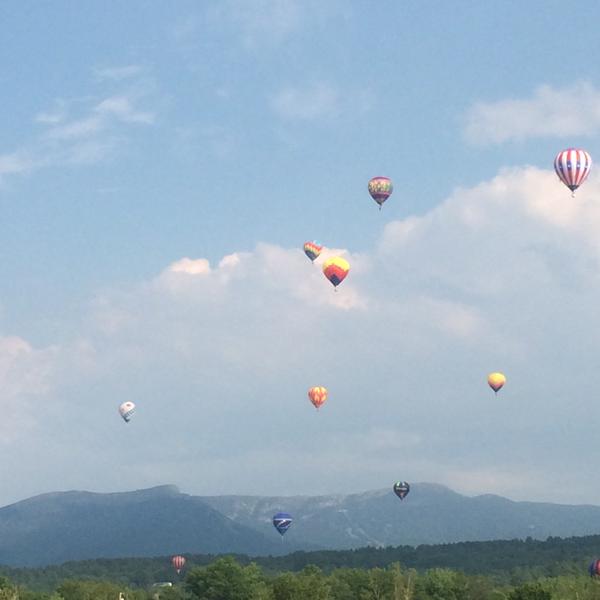
As I walk towards the registration table I hear a whoosh sound overhead. As I look towards the sky my eyes are greeted by a dozen or more hot air balloons, spanning from almost directly overhead to Mount Mansfield in the distance.  I’ve been to races where there have been flyovers by military jets, but never has there been a hot air balloon flyover.  Today’s race happens to coincide with the Stowe Balloon festival. Hence, the sky full of balloons. Regardless of the reason, it makes for quite a festive start to the day.


Going into the day my mind had been filled with clutter and mental gunk from a busy, stressful week. The demands of everyday life and running a business had been weighing on my mind. I was excited to run today but I was still, nonetheless, slightly distracted. The impressive display of balloonery, however, helped put me in good spirits.


I arrive at the registration booth, after completing my form and submitting payment for the entry fee I am handed a free jar of Bove’s pasta sauce(one of the race’s sponsors) and a lively colored orange race t-shirt. I return to my car equipped with my race booty, then proceed to suit up and warm-up. I still have 50 minutes until the start so there is plenty of time to prepare.


At last the time to report to the starting line is at hand. The start is on a gravel road in an athletic field.  I line up a few rows from the front. I’m not going to win this thing but I do intend to run fast enough to require being able to separate myself from the pack as soon as possible.


5….4….3….2…1…. Go!  We are off and running. The first tenth of a mile (approximately) of the course remains gravel before turning onto a paved road. I stay within the pack while on gravel, but as we turn onto the paved road I look for areas to run more freely. The left side of the road allows me to do this as there is more space between runners.  So, that’s where I steer myself. 


Going into this race I decided I was going to enact the strategy of having a controlled start, running the first mile at a slower pace than my 6:38 target.  This would allow for additional warm-up and enable me to feel out what my capabilities are. The number 6:45 entered my mind as a good target pace. After crossing mile one and hitting the “split time” key on my watch I see that my time for mile 1 is; drumroll……………….6:45. Right on pace! 


I’m loosening up and feeling good. These facts combined with the fact that mile 2 is flat makes me decide to increase my pace a bit. I cross mile 2 with a split time of 6:25. Mile 3 is one of the tougher ones because it has a short but steep hill as Luce Hill Rd turns onto Barrows Rd which goes by Stowe High School. Therefore, my goal is to just maintain a sub 7 minute pace, then make up any lost time on the back side as the course goes downhill through mile 4 after the high school.


Upon reaching this section, I find the downhill to be very refreshing.  My pace increases almost effortlessly while the trees are making for very helpful spectators, providing substantial amounts of shade.  I cross mile 4 in 26:30, pretty much at my pace for the 2012 race. The upcoming sections of the course are rolling, with no major inclines. However, there will be little relief from the sun, which is now beating down more intensely with the humidity rising, causing a double whammy (pardon me for incorporating fancy meteorological terms..lol). Therefore, even though I’m feeling strong, maintaining this pace is by no means a sure thing.


As I continue along at what feels to be a consistent pace I gradually reel in runners who I have seen in the distance ahead of me. I’m not sure how many runners are ahead of me, but it doesn’t seem like it could be a large number. I’m also curious as to how many there are ahead of me in my age group, which is 40-49. When I ran this race in 2012 the age groups were in 5 year increments so I took home a plethora of goodies as a result of finishing second in the 45-49 division. Doing so again this year will be significantly more challenging with the larger range in ages within the division.  Really that’s not a major concern though. Today’s race is primarily against the clock.


At mile 5 I begin to feel some heaviness in my legs, the heat and humidity are taking their toll, causing some effects of mild dehydration to make my pace feel more laborious.  As the course turns left off from the Moscow Rd and onto the River Rd there is a short, yet steep feeling ascent.  There is a runner who appears to be in his early to mid twenty’s who has stopped to walk up this hill. He has the leanness of a fast runner. He must have been done in by the heat.  “Just keep the legs moving Moe”, I think to myself, “and then open up your pace again at the top.”


Upon reaching the summit of this mini-mountain I see water.  Water in cups! Water from hoses!  This is no mirage. There is a hose perched atop a ladder raining water down to the ground below, enabling runners to run through and cool off.  I, of course, am happy to partake. This water is perfectly timed, I think to myself as I run underneath this makeshift rain cloud.  Ah, sweet exhilaration!


Immediately following the hose is a water station. Now that, for the time being, my external need for water has been satisfied I can deal with my internal need. I grab a cup and drink it down.


Upon consuming the water and discarding the cup I spy yet another hose perched above the course a few feet ahead. I capitalize on what will most likely be my last chance for cooling off and run through this second rain station.  All this water has enabled me to feel some rejuvenation. I charge forward to make my assault on the final 3 miles. 


As a result of the water I’m able to pick up my pace a bit and I feel stronger too. The remaining miles don’t have any major terrain changes so my plan is to put myself on cruise control and then unleash whatever I have left during the final mile. This current stretch is flat and on a dirt road, so aside from the heat it makes for good running. I steadily make progress on some of the runners ahead of me and end up passing several.  


At mile 7 the course enters Stowe village before turning up the Mountain Road for the final stretch. Here is where I shift into a higher gear to give everything I’ve got left.  As I exit a short stretch of bike path that connects with Route 100 in Stowe village I see another runner about 10 seconds ahead of me. This guy has been in front of me the entire race, I’d love to finally pass him but I need to do it strategically so he doesn’t pass me back. 


The turn from Route 100 onto the Mountain Road is upon us. This means there’s about a half mile to go. I hang back and, for now, avoid additional acceleration as the course takes us across a bridge over the Little River. Immediately after the bridge, the road turns right. At this point the road has a gradual but constant incline. This is where I choose to make my move. With only about four tenths of a mile to go I know that I can kick it in all the way from here.  I pass this runner I’ve had my eye on for several miles and never look back.


I dig deeper into my fuel reserves and pick up my pace. I know that very soon I will round a bend and see the turn for the finish by The Golden Eagle Resort.  However, I still need to make sure I don’t begin my final sprint too soon. I round the first bend and see another runner potentially within striking distance. With each foot strike I move closer and closer to him. I’m reeling him in, but even so, there may not be enough distance between us and the finish line to catch him.


After rounding the next bend I hear an increased amount of cheering and spectators are lined up on the right side of the road. I know the finish is right there, a short distance ahead.  I see the runner in front of me turn left onto Eagle Ridge Rd where the finish is located, which means that I will be unable to chalk up another victim. All I can do is just give whatever I’ve got left and finish as quickly as I can.  I cross the finish line in 53:58.


I ended up with a slower time than my 2012 race, however, I learned that overall I finished 9 places higher (24th vs 33rd). The heat and humidity definitely took their toll resulting in most people’s times (even the top runners) being 1-2 minutes slower than usual. The realization of this fact made me feel  ecstatic about my performance, just what I needed to push myself out of my funk.  Age group-wise I performed better than expected, finishing 5th out of 57 competitors (just 26 seconds shy of taking home a prize).


The stresses of life (aka the clutter) that consumed my mind at the beginning of the day were now completely replaced with happiness and a sense of being at peace; Thereby, proceeding to further emphasize the importance of incorporating challenge into our lives and stepping off of our normal well beaten path of routine.  It’s through challenging ourselves and stepping outside of our comfort zone that we gain a renewed appreciation for what is really important in life. Our threshold for discomfort is raised, which brings about a greater enjoyment of life as a whole. Additionally, we find out that we are capable of much more than we think.


As I sit on the deck at the Rusty Nail Bar and Grille with the sun beating down on my face and a Smuttynose (another race sponsor) Old Brown Dog Ale in my hand, I reflect on how important it is to celebrate.  For life is best enjoyed with balance. Work hard and challenge yourself, but take time to celebrate your accomplishments and life itself.


Tuesday, February 10, 2015

Running and Happiness (Slaying The Beast)

It’s 27 degrees; a tropical paradise compared to the persistent single digit temperatures that have become the daily standard of late. I’ve been getting much too familiar with the treadmill so I decide this is the perfect opportunity to take my run outside.  It’s 5:00 pm; daylight still dominates, but darkness will be setting in soon, so I strap on my headlamp and head out the door.


I take one of my standard routes which travels through the neighborhoods on the hill above me. I enter a short stretch of pedestrian path that connects the two neighborhoods.  New fallen snow blankets the earth and covers the trees along the path, muffling each foot strike and giving the appearance of passing through a white tunnel.  In the distance, headlights from a steady stream of traffic on the highway illuminate the horizon, but, like my footsteps, no sound is heard. With dusk setting it the experience becomes dream-like.  


An endorphin rush typically accompanies every run, but surreal moments like this amplify the experience.  I’m totally in the zone, running effortlessly in a state of solitude. Being in this state makes me think about how running really is a catalyst for happiness. Moments like this provide happiness, but it goes deeper. One of the major sources of happiness in life is constant improvement; challenging yourself, enhancing your skills and abilities. Doing so makes you feel alive. Running offers many opportunities for this to happen.


Beginning runners often have a goal of completing a 5K. Once this is accomplished, if so desired, plenty of other opportunities exist for progression and additional challenge, such as taking on a 10K, then the half marathon or even the marathon distance; beyond that there are ultra marathons. With any event an additional challenge of trying to improve time can be added. Furthermore, running can act as a stepping stone to other events such as the triathlon. Regardless of your experience or running history, there are always opportunities for continued challenge, growth and motivation.


I have been running since high school and have progressed in a manner similar to that which I just described. With 18 marathons behind me my focus now is on improving my time. The marathons I’ve run have been for the sake of experiencing different races and as a “carrot” so to speak; a source of motivation to keep my conditioning level high.  The majority of my marathons have been on hilly courses, so it was more about the experience. Now, I’m becoming more focused on improving my overall finishing time. With Father Time in pursuit of me I know the time is now for action! The goal; break 3 hours.  


I’ve heard breaking 3 hours in the marathon referred to in running circles as “slaying the beast”. This is fitting because it can feel like an intimidating creature at times. I’ve flirted with slaying the beast in the past and just 3 years ago came the closest yet, finishing in 3:02 at The Cox Sports Marathon in Providence, Rhode Island.  I was on pace through mile 21 but was done in by the hills near Brown University. How ironic that I was brought down by a University that shares my name.


I now have my sights set on the Vermont City Marathon this May for my next attempt. A quest which I have proclaimed as Operation 259; as in, the operation will be a success if I finish in 2:59 or less (I find assigning a title to a goal makes it more fun). The course does possess some rolling terrain but overall is conducive to a fast time.  I view the rolling terrain as a metaphor.  When pursuing a goal there will be highs and lows, challenges and victories, but by being persistent you will be successful. Plus, running in my own backyard will be more fun.  My quest will be updated in future blog posts.


Everyone, runner or otherwise, has a beast to slay in their life, or a barrier that seems impermeable. Whatever yours is, go at it with a vengeance! Don’t let it intimidate you. Be persistent! Sensations of power and happiness will follow.


Tuesday, November 11, 2014

From Staten Island To Central Park

The NYC Marathon is held on the first Sunday of November. Since this year's race was just recently completed I thought this would be a great opportunity to share my experiences from the race when I ran it in 2008.


It’s six o’clock am and I’m sitting under a tree behind a building at Fort Wadsworth on Staten Island.  Fort Wadsworth is a military base located by the Verrazano-Narrows Bridge.  Today it is also the ‘Athlete's Village.’  It’s where everyone participating in the marathon awaits the start. 

Due the fact that there are multiple street closings on race day, runners need to take one of the official transportation buses to ensure arrival at the start on time. With just under 40,000 runners to transport, buses leave from downtown Manhattan and New Jersey as early as 5 o’clock am.  This is why I’m at Fort Wadsworth hours before the 9:40 am start. 

I’m sitting under a tree behind a building to relax, conserve energy, and get some shelter from the wind.  The temperature is supposed to reach the low 50’s, however right now it’s cold and windy.  I don’t know the exact temperature but it’s somewhere in the low 30’s.  With the wind chill it’s got to be even colder.  Even with multiple layers on, it doesn’t take long for me to get cold.  I decide to get up, walk around, and get a hot beverage to help me stay loose and warm. 

As I walk around, I see people from numerous countries.  The New York City Marathon attracts runners from all over the world.  It is also, along with Boston, Chicago, Berlin, and London, part of the World Marathon Majors Tour.  The World Marathon Majors is a series of marathons in which runners accumulate points based on how they finish.  At the end of the tour, which takes place over approximately a 2-year period, the top male and female runners split $1,000,000 in prize money.  As a result, it attracts a high number of elite runners.  While I won’t be taking home $1,000,000, I still find it very exciting to be part of an event of this caliber.

I don’t want to use up too much energy, so I sit down once again.  There are some large tents set up for runners to sit down, stretch, and relax in.  However, after looking inside, I see that there does not appear to be much space for another body.  I decide to seek out another tree, but first, I have some business to take care of. 

I have to visit the port-a-potty.  Now normally, this wouldn’t be noteworthy, but as I quickly realize there’s no exposure to the wind, inside the port-a-potty is the warmest place in Athlete’s Village.  I’ll admit it, the thought of spending a couple more hours in here to warm up does cross my mind.  After all, there are hundreds of them with practically no lines.  Would anyone really know?  Maybe if the ambiance were better, I might consider this more.  But it is a portable public bathroom after all, so I exit and once again take a seat under a tree behind a building. 

After three hours of trying to relax, focus, and stay warm, the time has finally come for me to shed everything I’m wearing except for my race gear and report to my corral. A corral is a spot where runners gather just before being directed to their place at the starting line. Runners are assigned to a corral based on their expected finishing time.  Now the word corral conjures up images of thousands of runners being herded together like cattle.  While there are no race officials on horseback chasing runners to the corral, there are directions being given over the loud speakers. 

The corrals are gated areas in which race officials act like bouncers at a club, allowing only individuals assigned to the corral, to enter. Since I had qualified for a guaranteed spot in this year’s race, I didn’t have to win my entry via their lottery system. Therefore, I am positioned in a corral near the front of the pack. 

While standing at the start, I can feel an incredible amount of energy in the air.  There are competitors and reporters from all over the world.  The starting area is lined with buses and helicopters overhead.  Seeing the Verrazano-Narrows Bridge towering in front of me is an awesome sight.  I’m enjoying the moment and soaking in the entire experience, but at the same time, I’m very anxious to start. To quote Tom Petty, “the waiting is the hardest part.” 

Before the race starts, the elite men are introduced.  The elite women had a 9 o’clock start time and therefore are already running.  Mayor Bloomberg speaks to the crowd of runners and spectators, and of course, no sporting event is complete without the singing of the Star Spangled Banner. Once the preliminary events are complete, the starting gun fires.  The 2008 New York City Marathon has begun. 

Approximately the first 1.5-1.75 miles are spent crossing the Verrazano-Narrows Bridge.  There is a median strip in the form of cement barriers down the center, with runners occupying the entire bridge both the right and left sides of the median.  Whenever I compete in any running event, especially one of this size, I try to avoid being boxed in.  However, I quickly find myself with the median strip on my left, a wall of runners on my right, and not much room to run freely as a result. 

There’s a guy running in a SpiderMan costume in front of me who’s struggling to put his mask on.  There is just enough room to his right for me to squeeze by, so I pick up my pace long enough to get around him.  I take care not to interfere as I go by him, just in case this is the real SpiderMan on his way to fight crime somewhere.


There are so many runners on the bridge that I find it difficult to run comfortably.  Making progress involves running around people, while being careful not to trip myself or others. Because of this, I quickly realize that today is not a day for a personal best time.  There are just too many people to deal with.  I decide to make the focus just enjoying the whole experience.

As we exit the bridge, runners on the right side (which is the side I’m on) take one route, while the runners on the left take another.  We will meet again soon, no doubt. We approach mile 2, and there are thousands of spectators lining the streets.  The fist sign being held up by a spectator says, “welcome to Brooklyn.”  This is my first time in Brooklyn and there are thousands of people to welcome me.  How thoughtful! 

After running about a half mile through the streets of Brooklyn, we merge with the other lane of runners.  Seeing two groups of thousands of fast moving runners merge is a very surreal experience.  It resembles two fast-moving streams merging to form a powerful river.  To organize the merger of these forces there is a man-made median strip consisting of sawhorses with yellow police tape connecting them.  After about a mile, this median strip gives way to a series of traffic islands, which allows for less separation of the two lanes of runners. 

Much to my surprise, I soon spot another group of runners to my right.  It almost looks as if there is a separate race being run.  However, this group of runners then merges with us.  It turns out that there were runners on the lower deck of the bridge as well. 

Mile 3.5 is where all runners finally merge.  Because there are fewer runners on the left side, at mile 5 I decide to cross over at a break between the islands.  This allows me to open up my pace and run more freely.  It’s not until the 10k mark that I realize the error of my ways. 

It turns out that due to the separation of lanes when exiting the bridge, the runners on the left hadn’t run the same distance as those on the right.  They had run approximately 2/10 of a mile less.  I came to this realization when at the 10k mark, there was a section of matting on the road on the right side but not the left.  This matting is on the course every 5 kilometers, as well as at the halfway point.  It picks up the signal from a chip each runner wears on their shoe to determine their split times, as well as their official overall time.  This is no big deal, just that my 10k will show as being slower than it actually was. 

I figure there must be some type of course diversion soon to make the mileage for both sides of the road equal.  I didn’t want to get stuck running further than I had to.  Therefore, after passing the 10k mark for the left side of the road, I quickly switch back to the right side, where I should have stayed all along. 

Sure enough, at 8 miles this diversion occurs.  The runners on the left side of the road temporarily separate from those on the right side, only to reconnect a few minutes later.  From this point forward, the mileage is the same for both the left and right sides of the road. 

The course continues to wind its way through the spectator-filled streets of Brooklyn.  I’m feeling strong and averaging a pace of 7 minutes per mile.  I’m comfortable with my pace, and know it’s not unrealistic to maintain it.  I also am wearing a heart rate monitor to help ensure I pace myself correctly.  It’s easy under these circumstances to get an endorphin rush from all the cheering and go too fast.  My goal at this point is to keep my pace steady and avoid this temptation. 

At the half marathon mark, my time is 1:33.  As any runner knows, doing math while racing can be difficult.  However, it doesn’t take much effort to determine that I’m on pace for a 3:06 marathon.  It’s not a personal best, but I could certainly live very happily with that. 

I’m now running in Queens, with the crowds just as lively and numerous as they were in Brooklyn.  At mile 16, the course enters Manhattan via the Queensboro Bridge. The bridge starts at mile 15 and ends at mile 16.  There are no spectators on the bridge, but I can hear the distant roaring of cheering ahead.  At this point I have separated myself considerably from those runners behind me.  I feel like I am running on the bridge by myself.  I know this experience will be short-lived, so I try to enjoy it. 


A runner soon comes up behind me and starts to pass me on the left.  As I turn to see who it is, I quickly realize that it’s SpiderMan.  He’s ditched the mask and is now running with his face exposed for all of New York to see his true identity.  I think to myself, "I would like to beat SpiderMan, but if I don’t it’s not a big deal, he is a super hero after all."

During the final ¼ mile on the bridge, I approach yet another person running in costume. This time it’s someone dressed as Minnie Mouse. I didn’t know Minnie was a runner; I don’t recall any mention of her in the Celebrity Runner’s section of the race program.  As I pass, I turn to look at Minnie.  Much to my surprise, this person dressed as Minnie, is a man.  Now I’ve been a runner for over 30 years, and I’m a competitive person.  At this point, I’m not as concerned with who beats me, as long as I know I gave 100% and ‘put it all out there’ so to speak. I quickly decide though, that there is absolutely no way I’m going to be beat my Minnie Mouse. I pass Minnie and never look back. 

After exiting the Queensboro Bridge, the course enters Manhattan. While I’ve never competed in the Olympics, I’ve got to believe that this experience is comparable (at least in regards to energy in the air) to an Olympic Marathoner running through the tunnel and entering the stadium near the finish.  It goes from quiet to crazy.  There is so much energy and excitement from the crowds that it takes extra focus to maintain my pace.

The course turns onto First Avenue, which is also lined with cheering crowds every step of the way.  This is a good thing because the course is starting to get tough, and the extra motivation they provide is extremely helpful.  What makes this part of the course tough is that it’s absolutely straight for 4 miles.  This makes it tough mentally. I look ahead and see runners miles ahead that aren’t turning.  They’re just going straight; It’s like they’re running to infinity.  I don’t want to run to infinity!  What makes this part of the course physically tough is that there’s a gradual incline that also never seems to end.  Not only are we running to infinity, we’re doing it uphill! 

Finally the course levels out as we enter the Bronx at mile 20. I’m still maintaining my pace, but I’m doing it a little more laboriously. I’ve been hydrating and taking Gu Energy Gel regularly throughout the race, but this is a common feeling. I believe it was Olympic Marathoner, Frank Shorter, who once said, “a marathon consists of two halves: the first half is miles 1-20, and the second is miles 20-26.2. “ I’ve now entered this ‘2nd half.’

The time and effort required to run one mile feels doubled. This is where the mental component of the race becomes prevalent.  I’ve been running marathons off and on for at least 16 years. In that time, I’ve found that the best way to deal with the mental and physical challenge of the last 6.2 miles is to count them down in my mind.  Along with this, I break the remaining miles down into segments.  For example, from looking at the course map prior to the race, I recall that the course enters Central Park at mile 23.  I make this my short-term goal.  Instead of 6.2 miles to go, there are only 3 miles until Central Park.  When I reach Central Park, I’ll then break down the remaining mileage into additional segments. 

The course only goes through the Bronx for 1 mile, re-entering Manhattan at mile 21, and going through Harlem around mile 22. The spectator support is still tremendous and energizing. At this point I’m just focused on keeping my legs moving, keep my pace, and counting down the miles.  I feel like I’m shuffling through Harlem. Somehow I don’t think that this is what the Rolling Stones had in mind when they sang, “Do the Harlem Shuffle.” 

I’ve been getting water or Gatorade at each station, and taking electrolytes throughout the race.  I’m still noticing some of the effects of dehydration though.  It’s taking more effort to maintain my pace, and the surest sign of all, I’m thirsty. I decide that at each and every water station from this point forward , that I’m going to get both water and Gatorade.

 I continue to chug along at what feels like a steady pace. However, my split times are increasing and my pace has gone from 7 minutes per mile to about 7 minutes, 10 seconds. I can often maintain a strong and consistent pace through the final miles of a marathon. Today my pace just seems to be fluctuating.  I’m experiencing peaks and valleys in my energy.  I try to enjoy my peaks and focus on keeping my legs moving through the valleys. 

Finally I reach Central Park. While this is a great moment because there are only 3.2 miles to go, I’m not too pleased to discover that upon entering the park the course steadily inclines. It’s a gradual incline that seems to continue on for miles.  In actuality, it was probably only a ¼ of a mile. I keep my eyes focused on the road about 25 feet in front of me, and focus on chugging along to get the next mile marker. 


At the 40k mark, I cross the final set of matting before the finish to detect my split time with the chip in my shoe.  I’m too fatigued to do much math, but I do know that 40 kilometers is a little less than 25 miles.  I think to myself, "Hallelujah I’m almost at the one mile to go mark", which in my mind at that point, was the 2nd best point of the race.  Number one is obviously the finish line. 

The course continues to wind its way through Central Park.  There’s enough distance between the runners in my vicinity and me to make it feel like I’m the center of attention.  It’s too bad that I can’t put on a better show and pick up my pace for a nice, strong kick to the finish.  That’s not going to happen today though.  I just hope I don’t look as bad as I feel.  I’m tired and really hungry.  Thanks to the incline, my pace over the last mile was down to 8 minutes, which is well below my normal race pace. 

I continue to have peaks and valleys in my energy level, only now the peaks don’t last as long.  I haven’t hit ‘the wall,’ but I can see it lurking up ahead.  If this race were 26.3 miles instead of 26.2, I’d probably hit it. 

Finally I reach the 26-mile mark, another bittersweet moment.  There are only 2/10 of mile to go, but it’s uphill, not a steep incline thankfully, but a gradual one nonetheless like the others.  In this case though, the sweet outweighs the bitter.  While my fatigued state has probably given me a false perception of the incline, the fact that I’m practically at the finish makes me not mind having to shuffle my tired legs up any hill.

I give my all to get to the finish as quickly as I can, crossing in 3:11:13, 1,855th place overall. My time is a palindrome! It’s not a personal best time, but one I’m certainly happy with, and while I may have had 1,854 people ahead of me, there were at least 37,135 behind me.  I did finish ahead of Minnie Mouse, but I’m not sure about SpiderMan.  That doesn’t matter though.  Despite being tired and really hungry, I feel incredible.  I just ran the NYC Marathon!